
The 12" Single — How a Disco Format Ate Dance Music
Why the 12 inch, 45 RPM single became the most important format in club music — and why DJs are still cutting them today.
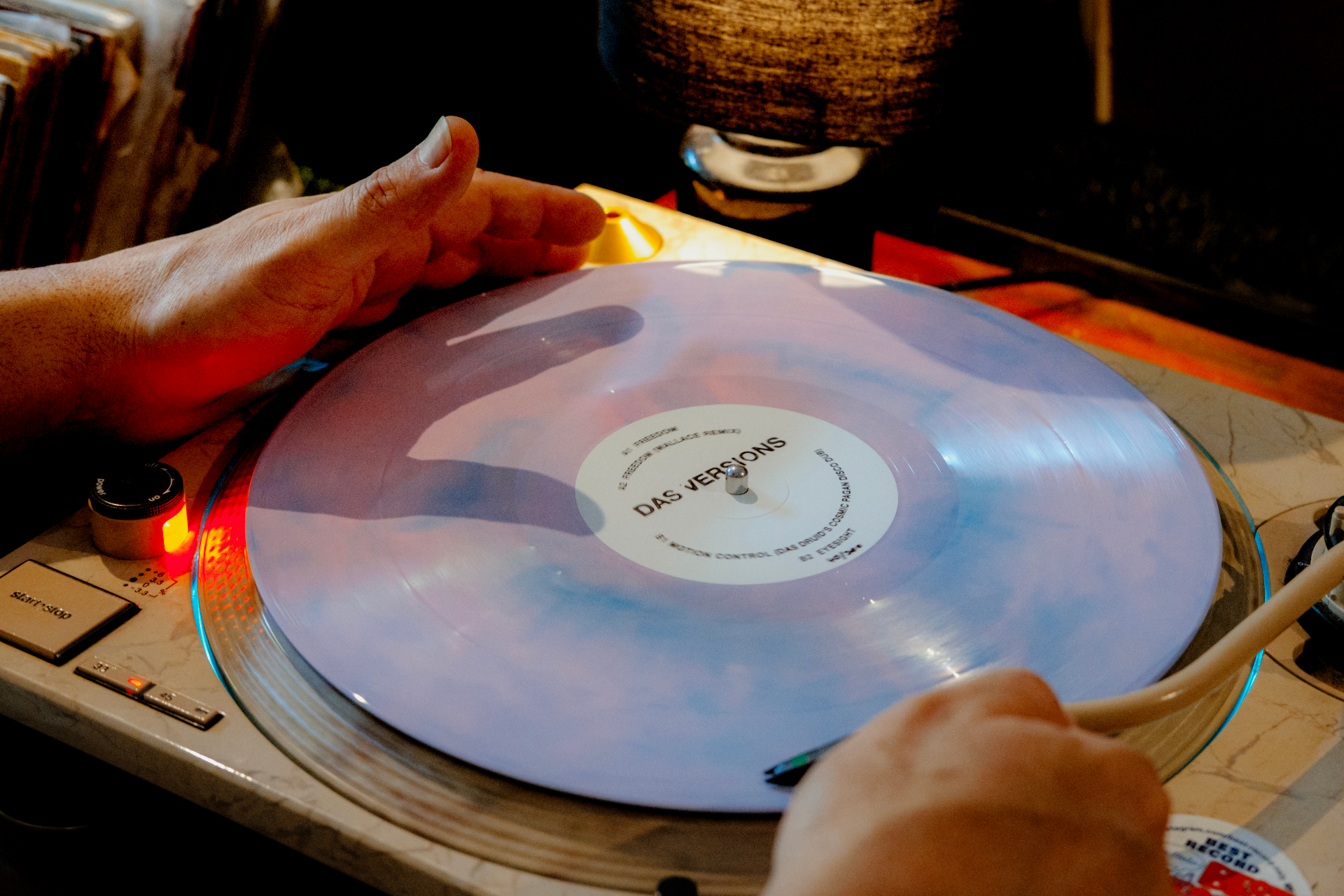
The 12 inch single is the same size as an LP but usually plays at 45 RPM, with one track per side. It was invented by mistake — Tom Moulton and mastering engineer José Rodríguez cut a promo on a 12 inch lacquer in 1975 because they'd run out of 7 inch blanks, and discovered the extra width meant louder cuts, deeper bass and dramatically better sound. DJs in New York disco rooms picked it up immediately.
The wider groove is the whole point. On a 7 inch, a mastering engineer has to compress dynamics and tame low end to fit the runtime. On a 12 inch playing one track, they can spread the groove wide, cut hot, keep the sub-bass intact, and give the record the volume it needs to work on a club system. That's why a 12 inch of a disco or house track sounds fundamentally different — bigger, punchier, more physical — than the same song on an album.
Every dance movement that mattered ran on 12s. Disco. Hip hop instrumentals and DJ tools. Chicago house. Detroit techno. UK garage. Jungle and drum and bass. Grime dubplates. The 12 inch is where DJs meet producers directly — no label edit, no radio version, just the club mix, dubs and instrumentals on one heavy piece of vinyl.
Collectible 12s tend to be first pressings of records that changed a scene — Frankie Knuckles 'Your Love', Rhythim Is Rhythim 'Strings of Life', MFSB 'Love Is the Message' promo mixes, early Trax and DJ International, Metroplex, R&S, Warp early catalogue, Metalheadz. Original US and UK pressings almost always outperform later repress runs, both sonically and on the resale market.
The format is also alive. Small dance labels still press 12s in runs of 300 to 500, DJs still buy them, and cutting houses in Berlin, London, Detroit and Tokyo still specialise in mastering for the format. If you want to understand why club culture is a vinyl culture, the 12 inch is the answer.
The Moulton origin story bears retelling in detail because it explains a lot about the modern club record. In 1975, Tom Moulton was cutting a promo edit of Al Downing's 'I'll Be Holding On' at Media Sound in New York with engineer José Rodríguez. When Rodríguez ran out of 7 inch acetate blanks, he cut the promo on a 10 inch blank instead — and then, on a second job, on a 12 inch blank. The result was audibly louder, wider and richer than any single-side 7 inch of the same track. Salsoul Records and Scepter picked up the format for their disco promos almost immediately, and by 1976 the commercial 12 inch (starting with Double Exposure's 'Ten Percent' on Salsoul) was on shop shelves. That accident is why every DJ bag on Earth is built around a 12 inch shape.
Disco 12 inches on Salsoul, West End, Prelude, TK, Sam and Casablanca are their own collector universe. Walter Gibbons's Salsoul mixes ('Hit and Run', 'Nice 'N' Nasty', Double Exposure's extended versions), Larry Levan's remixes for West End (Taana Gardner 'Heartbeat', Peech Boys 'Don't Make Me Wait', NYC Peech Boys), Tom Moulton's own mixes for Salsoul, and Francois K's early Prelude 12s essentially wrote the grammar of the modern extended mix. Original US pressings of these — particularly the promo-only white labels and the early Salsoul 12s in their picture sleeves — are steadily appreciating as the last generation of buyers who saw them in the shops firsthand age out.
The Chicago house 12 inch is the next chapter. Trax Records (Larry Sherman) and DJ International (Rocky Jones), both operating out of Chicago from roughly 1984 to 1991, released the foundational house catalogue on notoriously variable-quality vinyl — Trax in particular is infamous for pressing on recycled PVC, which means clean copies of Marshall Jefferson's 'Move Your Body', Adonis's 'No Way Back', Phuture's 'Acid Tracks', Mr. Fingers' 'Can You Feel It' and Frankie Knuckles' 'Your Love' are genuinely rare not because the pressings were small but because most surviving copies are worn out. First pressings with the original labels and hype stickers now regularly clear $300–$800 in NM condition.
The UK hardcore, jungle and drum-and-bass 12 inch is a completely separate collector economy. Reinforced, Suburban Base, Moving Shadow, Metalheadz, Ram, Prototype, Photek Productions, Good Looking, V Recordings and the endless white-label and dubplate scene of 1992–1998 pressed 12 inches in runs of 500 to 2,000, and almost all of them were played to destruction on club rigs before the internet made it possible to trade them intact. A clean Metalheadz META-001 (Wax Doctor 'Kid Caprice / Deep Blue 'The Helicopter Tune'), Photek 'Ni Ten Ichi Ryu', or LTJ Bukem 'Music' on Good Looking regularly clears $200–$500 today, and the UK dubplate scene of the era (Randall, Fabio, Grooverider, Andy C, Bryan Gee cutting one-off acetates at Music House on Holloway Road) produced literally thousands of records that only ever existed as single copies.
The garage-house and UK garage 12 inch continues the story. Masters at Work, Kerri Chandler, MK, Dennis Ferrer and the whole Strictly Rhythm / Nervous / King Street mid-90s New York house 12 inch scene sits alongside the UK garage explosion (Tuff Jam, MJ Cole, Wookie, Todd Edwards's Sound Signature remixes for Daft Punk) as one of the most consistently overlooked collector categories in club music. Original Strictly Rhythm 12s from 1990–1996 with the original sleeves are increasingly hard to find in clean shape and prices have finally started catching up. Look for the earliest catalogue numbers (SR12-001 through SR12-100) — those are the ones with the deepest historical value.
The grime and dubstep 12 inch is the most recent chapter that has already fully entered the collector economy. Original White dubplates from FWD>>, DMZ, Rinse, Tempa, Skull Disco, Deep Medi, Hessle Audio, Hotflush and the various early Digital Mystikz / Kode9 / Loefah / Skream / Benga / Coki catalogue-number 12 inches now trade at multiples of their original £6.99 price. The physical objects were minimal — plain white sleeves with hand-stamped labels — but the runs were tiny (often 300–500) and most of them were destroyed by the DJs who bought them. Fabric's Farringdon nights, DMZ at Mass in Brixton, and FWD>> at Plastic People in Shoreditch are the rooms these records were engineered to work in.
The current small-label 12 inch scene is arguably the healthiest sector of the physical dance-music market. Rush Hour (Amsterdam), Hessle Audio (London), Livity Sound (Bristol), Ilian Tape (Munich), Giegling (Weimar), L.I.E.S. (New York), The Trilogy Tapes (London), NAFF (Berlin), Whities / AD 93 (London), Version (Chicago), and dozens of similar imprints keep 12 inches in print in editions of 300–1,000, sell them through a network of specialist shops (Hard Wax Berlin, Idle Moments Amsterdam, Phonica London, Honest Jon's, Kristina Records, Rush Hour), and the entire ecosystem functions as the tastemaker layer of contemporary electronic music. Streaming services do not surface these records; the 12 inch and the specialist shop still do.
For the collector, the mastering side of the 12 inch story is where the object becomes an audio product rather than just a container. Cutting engineers matter enormously — Bob Weston at Chicago Mastering Service, Rashad Becker at Dubplates & Mastering in Berlin, Frank Merritt at The Carvery in London, Matt Colton and Miles Showell at Metropolis and Abbey Road respectively, and Ron Murphy's National Sound Corporation legacy in Detroit — each has a specific sonic signature that serious DJs can identify. A 12 inch cut by Rashad Becker or Frank Merritt in 2024 will sound audibly different, and audibly better, than the same record cut by a generic pressing plant with no dedicated mastering engineer. That is the difference between an object and a tool.