Northern Soul — The Movement That Turned Forgotten 45s Into Religion
Wigan, the Twisted Wheel, all-nighters and thousands of obscure American soul 45s — how a northern English dance scene rewrote record collecting forever.
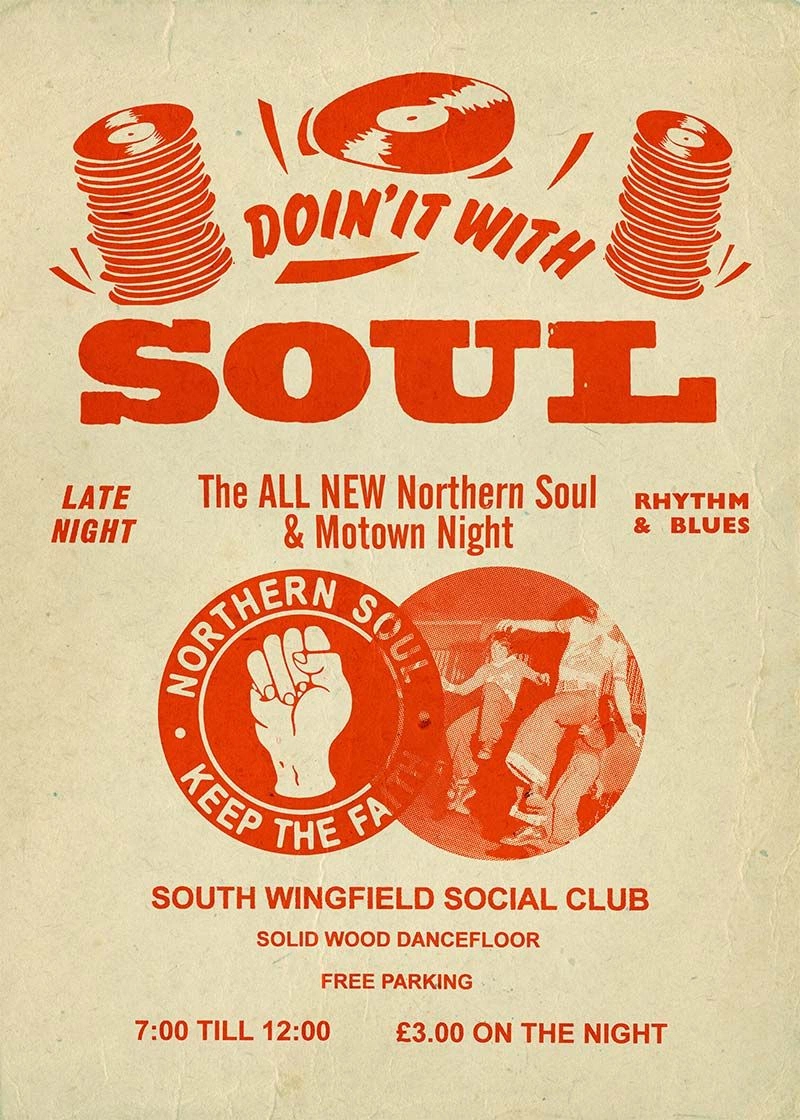
Northern Soul is the strangest and most enduring record-collecting culture in the world: a British working-class dance movement built almost entirely on American soul singles that failed commercially in America. Records pressed in Detroit, Chicago, Philadelphia and a hundred small studios in between, that sold a few hundred copies and got deleted, found a second life a decade later on wooden dancefloors in the north of England, at four in the morning, played to people doing backdrops and spins in vests and high-waisted trousers.
The name came from a shop counter. Dave Godin, who ran Soul City Records in London and wrote for Blues & Soul, noticed in the late 1960s that customers travelling down from Manchester, Stoke and Blackpool wanted a specific thing — fast, stomping, mid-1960s uptempo soul in the classic Motown mould — while London buyers had moved on to funk and the emerging deeper, slower sound. He started labelling that stock 'northern soul' for his staff. The name stuck to the entire scene.
The scene's roots are in the mod clubs of the mid-1960s. Manchester's Twisted Wheel, which opened in 1963 and ran all-nighters from 1965, is the accepted starting point. It played American R&B and soul imports to a mostly working-class, amphetamine-fuelled crowd who danced from midnight until dawn because the trains didn't run and the pubs shut at eleven. When the Wheel closed in 1971 under police pressure, the scene didn't die — it multiplied.
What followed is the canonical run of venues. The Golden Torch in Tunstall, Stoke-on-Trent (1972–73). Blackpool Mecca's Highland Room, where DJs Ian Levine and Colin Curtis pushed the sound forward into early disco and split the scene in the process. Va Va's in Bolton. The Catacombs in Wolverhampton. And above all Wigan Casino, which ran all-nighters from September 1973 to December 1981, drew over a hundred thousand members, and was voted the best disco in the world by Billboard in 1978 — a club in a decaying Lancashire mill town that most Americans had never heard of. Later, the Stafford Top of the World and the 100 Club all-nighters in London carried the flame into the 1980s and beyond.
The music itself has a tight definition and an enormous catalogue. The template is uptempo 4/4 soul at roughly 100 to 130 BPM, built on a heavy backbeat, driving bass, orchestrated strings or horns, and a desperate, straining lead vocal. Think the Motown formula executed by everyone who wasn't Motown. Between roughly 1963 and 1972 the American independent soul industry pressed a staggering volume of exactly this: thousands of small labels — Ric-Tic, Golden World, Mirwood, Okeh, Shrine, Karen, Cameo-Parkway, Wand, Loma, Brunswick, Dade, Thelma, Revilot, Solid Hit — each issuing runs of 500 to a few thousand 45s that mostly sank without trace. Estimates put the number of distinct American soul 45s released in that decade in the tens of thousands. That vast, failed, over-produced inventory is exactly what made Northern Soul possible.
The collecting culture that grew around it was unlike anything before. Because the records had flopped, they were not in shops — they were in warehouses, in radio station discard boxes, in distributor dead stock in Ohio and Georgia. British collectors and DJs flew to America specifically to buy them by the box, and a professional class of record finders emerged: John Anderson's Soul Bowl in Norfolk imported American stock by the pallet and supplied the entire scene for years. A DJ's status rested entirely on having records nobody else had, which is why so many played with the labels covered up or deliberately mislabelled to stop rivals identifying a tune.
Those tactics created the price structure the scene still has. Frank Wilson's 'Do I Love You (Indeed I Do)' on Soul — a 1965 Motown single almost entirely destroyed before release, with two known surviving copies — has sold for over £25,000, one of the highest prices ever paid for a 7 inch. Darrell Banks' 'Open the Door to Your Heart', the Salvadors' 'Stick By Me Baby', Larry Williams' 'I'll Be Yours' on Mercury, and Rita and the Tiaras' 'Gone With the Wind Is My Love' all trade in the thousands. The scene invented the modern rare-45 market, and it set the convention — still followed globally — that condition, label variant and original-pressing status determine value far more than the artist's fame.
The dancing is inseparable from the records, and it's why the music still functions. Northern Soul dancing is athletic and largely improvised — spins, drops, backdrops, high kicks, glides on talc-dusted wood — and it demands a very particular kind of record: fast enough to sustain it, with a beat clear enough to hold a floor of individuals all doing their own thing at once. That requirement acted as a brutal filter. A record only entered the canon if it worked physically, at volume, at 3am, for people who had heard everything. Fifty years of that filtering produced a body of dancefloor music with an almost unnaturally high hit rate.
Which is precisely why DJs across completely unrelated scenes keep coming back to it. A Northern Soul 45 is short, loud, mastered hot on a 45 RPM cut with wide groove spacing, and structurally engineered to make people move within eight bars. There's no long intro to mix in, no ambient wind-up, no wasted bar. Play one in a modern club, a wedding, a warehouse or a bar and it works instantly, because the record was already tested by the most demanding dancers in Europe before you were born. Keb Darge, Andy Smith, Kenny Dope, DJ Format, Mr Bongo and the entire funk-45 DJ tradition are direct descendants of this culture.
The scene also produced an ethic that record culture still runs on: 'Keep the Faith', with the clenched fist logo. It meant loyalty to the music over commercial trends, to the all-nighter over the charts, and to records that the industry had thrown away. It carried an unmistakable class politics — this was Britain's industrial north in the 1970s, in the middle of decline and strikes and closures, and the response was to build an ecstatic, immaculately dressed, all-night alternative world out of imported American records nobody else wanted.
Fifty years on it hasn't stopped. The 100 Club all-nighters still run. Weekenders at Cleethorpes, Blackpool, Skegness and Prestatyn pull thousands. Reissue labels — Kent Records under Ace, Outta Sight, Athens of the North, Soul 4 Real — have made hundreds of formerly £500 records available for a tenner, which has widened the audience rather than devaluing the originals. New generations arrive via the dancing as often as via the music, and there are Northern Soul nights running now in Tokyo, Melbourne, Berlin, New York and Barcelona.
If you want to start, start with the compilations rather than the auctions. Ace's Kent catalogue is the single best-curated body of this music in existence. Then move to 7 inch originals in the £10–40 range, which is where the vast majority of the canon actually sits — the five-figure records are famous precisely because they're outliers. Buy a 45 spindle, a decent cartridge that tracks worn vinyl kindly, and accept that most originals will have some surface noise from being played to death in exactly the rooms that made them matter. That noise is the provenance.