Krautrock on Vinyl — The German Underground That Rewrote Modern Music
Neu!, Can, Kraftwerk, Cluster, Faust, Harmonia, Ash Ra Tempel — why the early-70s West German avant-garde is still the most influential secret in your record collection.
In the late 1960s a generation of West German musicians looked at the Anglo-American rock template and quietly decided none of it applied to them. No blues roots, no verse-chorus, no showmanship — instead: motorik pulse, tape loops, analogue synths, group improvisation and studios run like laboratories. The British music press coined the name 'Krautrock' as a mild insult. It stuck, and the records outlived the joke.
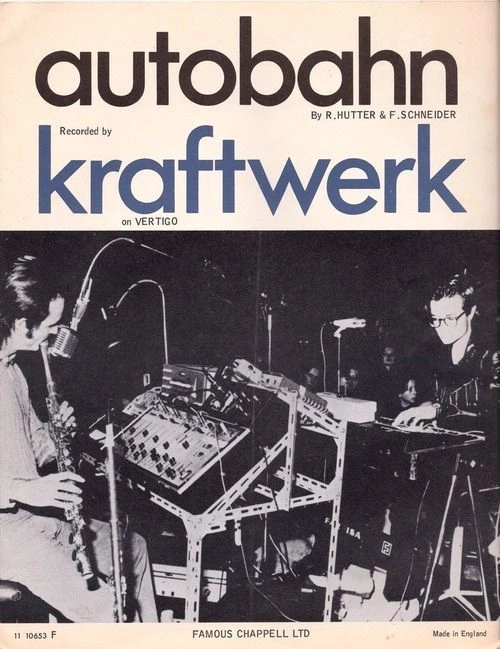
The four cornerstones are non-negotiable. Neu!'s self-titled 1972 debut, built on Klaus Dinger's motorik beat, is the record that every guitar band since Stereolab has quietly re-recorded. Can's 'Tago Mago' (1971) and 'Ege Bamyasi' (1972) are the funk-punk-jazz-tape-collage template every producer from Radiohead to Kanye has referenced. Kraftwerk's 'Autobahn' (1974) and 'Trans-Europe Express' (1977) invented electronic pop as we understand it. Cluster and Harmonia — Roedelius, Moebius and Michael Rother — sketched the ambient blueprint Brian Eno then bought a ticket to Germany to learn from in person.
The deeper you go the better it gets. Faust's early Polydor LPs (the clear-vinyl 'Faust' and 'Faust IV') sit somewhere between musique concrète and rock. Popol Vuh's ECM-adjacent spiritual records — 'Hosianna Mantra', 'In den Gärten Pharaos' — soundtracked half the Werner Herzog catalogue. Ash Ra Tempel, Amon Düül II, Guru Guru, Agitation Free, La Düsseldorf, Michael Rother's solo LPs, Manuel Göttsching's 'E2-E4' (still the most quietly influential dance record ever made) — every one of them rewards the dig.
The vinyl market has caught up hard. Original German pressings on Brain, Ohr, Kosmische Kuriere, Sky and early Kraftwerk on Philips have moved from cult money to serious money over the last decade. 'E2-E4' first pressings on Inteam, private-press Popol Vuh, and mint OG Neu! records regularly clear four figures. Reissues are excellent — Grönland (Neu!, Harmonia, Cluster), Mute (Can), Kling Klang / Parlophone (Kraftwerk's remastered box), Bureau B (Cluster, Roedelius, Moebius) — but the OGs still sound different, and the market knows.
If you're starting: Neu! '75, Can 'Ege Bamyasi', Kraftwerk 'Trans-Europe Express', Harmonia 'Musik von Harmonia', Cluster & Eno 'Cluster & Eno', Manuel Göttsching 'E2-E4'. Play them in that order across an afternoon and you'll hear the second half of the twentieth century get invented.
The Conny Plank chapter is essential and rarely credited outside German-speaking sources. Plank ran a converted farmhouse studio in Wolperath outside Cologne, and between 1971 and his death in 1987 he produced or engineered a staggering slice of what people now call krautrock: Neu!, Cluster, Harmonia, Kraftwerk's first three albums (before they built Kling Klang), La Düsseldorf, Guru Guru, Devo's early Warner records, Ultravox, Eurythmics, Killing Joke's 'Night Time', A Certain Ratio, and Michael Rother's solo trilogy ('Flammende Herzen', 'Sterntaler', 'Katzenmusik'). If you want a shortcut to a decade of great records, the entry 'produced by Conny Plank' on the sleeve is one of the most reliable quality signals in the entire secondhand market.
The Cologne school and the electronic-music research that predated krautrock are the other missing prehistory. Karlheinz Stockhausen's studio at WDR Cologne, running from 1953, is where Irmin Schmidt of Can and Holger Czukay (also of Can) both studied. That is a direct line from the 1950s European avant-garde to a rock band in 1971 — and it's why Can's improvisations sound structurally different from any Anglo-American band of the same era. Stockhausen's 'Gesang der Jünglinge' and 'Kontakte' are technically outside the krautrock canon but functionally inside its bloodstream. So too are the early works of Eberhard Schoener and Peter Michael Hamel.
The Berlin School is a distinct scene within the wider category and deserves separate shelving. Tangerine Dream (Edgar Froese, Christopher Franke, Peter Baumann) on Ohr and later Virgin — 'Alpha Centauri', 'Zeit', 'Phaedra', 'Rubycon', 'Stratosfear' — plus Klaus Schulze's monumental solo run ('Irrlicht', 'Cyborg', 'Timewind', 'Moondawn', 'Mirage'), Ash Ra Tempel's Manuel Göttsching side, and the wider Cosmic Jokers / Kosmische Musik axis around Rolf-Ulrich Kaiser's Ohr and Kosmische Kuriere labels. This is where the modern ambient template, film scoring template, and long-form electronic composition all effectively originate.
Kraftwerk deserve a paragraph of their own because they are, in retrospect, the single most influential group of the last fifty years. Every genre invented after 1980 that runs on machines — hip hop (Afrika Bambaataa's 'Planet Rock' is essentially a Kraftwerk cover), Detroit techno (Juan Atkins was studying 'Trans-Europe Express' in high school), synth pop, electro, house, IDM, EDM — begins with what Ralf Hütter and Florian Schneider built at Kling Klang in Düsseldorf. The four-album run of 'Autobahn' (1974), 'Radio-Activity' (1975), 'Trans-Europe Express' (1977) and 'The Man-Machine' (1978) is arguably the most important consecutive sequence of records in electronic music history. The 2020 death of Florian Schneider closed a specific era; the catalogue is finite and permanent.
The reissue politics are worth understanding. Grönland Records (Herbert Grönemeyer's label) holds the definitive Neu! and Harmonia catalogues after decades of legal disputes between Klaus Dinger and Michael Rother. Bureau B out of Hamburg has systematically reissued the Sky Records catalogue (Cluster, Roedelius, Moebius, Michael Rother, Asmus Tietchens). Mute owns Can. Kling Klang / Parlophone controls the post-1974 Kraftwerk. Anything outside those imprints — particularly the Ohr, Kosmische Kuriere, Pilz and Brain original catalogues — should be treated with condition scepticism: the German small-label pressings of the early 1970s used variable vinyl quality and many copies have swim damage, warping or centre-hole wear that later reissues have deliberately corrected.
The influence chain outside music is worth naming. David Bowie moved to Berlin in 1976 largely on the recommendation of Iggy Pop and Brian Eno, both of whom had already been listening to Kraftwerk, Neu! and Harmonia; the resulting 'Low', 'Heroes' and 'Lodger' trilogy is essentially Bowie's Anglo-American translation of the Cologne / Düsseldorf sound. Eno's collaborations with Cluster and Harmonia (recorded at Conny Plank's studio in 1976 and 1977) fed directly back into his own ambient and Talking Heads production work. The whole 1980s British synth-pop scene (Depeche Mode, OMD, Human League) took Kraftwerk as gospel. Radiohead's 'Kid A' and 'Amnesiac' era is Can and Autechre in equal measure.
For deeper listening after the starter set, work by studio and producer rather than by band. If you like Neu! you will like Michael Rother's solo trilogy and La Düsseldorf. If you like Can you will like Damo Suzuki's later solo Damo Network live records, Holger Czukay's 'Movies' and 'On the Way to the Peak of Normal', and Jaki Liebezeit's Drums Off Chaos late-career percussion group. If you like Harmonia you will like Roedelius's endless Selbstportrait series on Bureau B, and Moebius / Plank collaboration LPs. If you like Kraftwerk you will like Yello, early Depeche Mode, and Wolfgang Voigt's Gas project on Kompakt. The scene is a web, not a canon.